Confirmed > 99% Lab-grade Peptides
Peptide Screening: Hplc & Mass Specification Pureness Guide Pinnacle

Measuring peptide purity is commonly performed with analytical high-performance liquid chromatography (HPLC), frequently paired with mass spectrometry (MS) for identification confirmation. These logical techniques are basic in peptide quality control and you will certainly almost always get HPLC and MS data with a research study peptide order. The key analytical methods for peptides consist of fluid chromatography (LC), normally HPLC, incorporated with mass spectrometry (MS) for exact molecular weight determination and sequence validation.
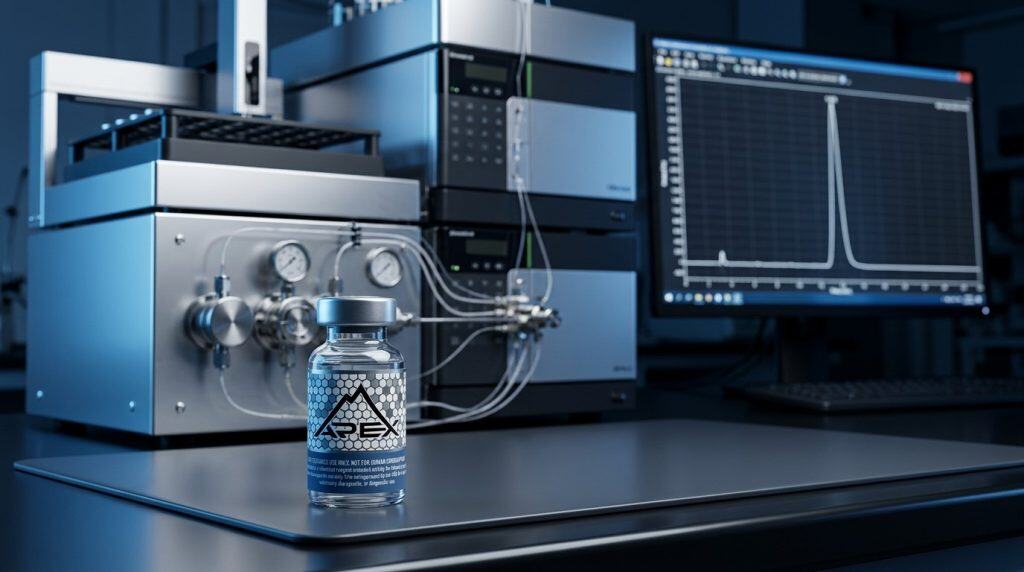
A useful assay measuring downstream signaling-- or a structural research study utilizing NMR or X-ray crystallography-- demands the highest purity available. Crystallographers particularly often call for ≥ 98% pureness due to the fact that also minor pollutants can avoid crystal formation or present problem into the crystal latticework. As molecules exit the column, they go through a detector-- commonly a UV detector set to 214 or 220 nm, wavelengths where the peptide bond takes in light strongly. The detector records how much UV light is absorbed in time, creating a chart called a chromatogram. This overview breaks down what pureness actually indicates in peptide chemistry, just how it's Quality Standards gauged, what the contaminations are, and exactly how to review the documents that proves a peptide is what it claims to be.
Peptide Useful Evaluation In Biomedical Study
This level of thorough analysis ensures the peptide's precision-- indicating the series and pureness are exactly as labeled-- which is essential for experimental reproducibility. By confirming structure via numerous validated methods, lab validation assurances that scientists receive a high-purity peptide that will perform as anticipated in the lab. Lab recognition of peptides is not just a clinical best technique-- it's often a regulatory demand when peptides are made use of in therapeutic advancement or professional research.- The mobile stage, typically a mix of water, acetonitrile, and an acid modifier, is kept in storage tanks and delivered through the system by a high-pressure pump.
- We provide physical home screening that aids groups function more effectively with tough samples.
- The mobile phase is a slope of water and a natural solvent like acetonitrile, often with a small amount of trifluoroacetic acid (TFA) to sharpen the tops.
The injector presents a precise quantity of example right into the mobile-phase stream. Constant shot quantity issues because straining the column can broaden heights, distort pureness quotes, or conceal nearby pollutants. A strong peptide testing workflow uses methods that address corresponding inquiries. The table listed below is the practical method to think of typical tests when checking out a peptide COA.
Research Study Uses Peptide Chemical & Physical Analyses
While peptide purity isn't the only aspect, utilizing inadequately identified reagents is an identified factor to irreproducible outcomes. For a 10-residue peptide with 99.5% combining effectiveness, you would certainly anticipate concerning 95% of the final product to be the full-length sequence prior to filtration. For a 30-residue peptide at the exact same performance, that drops to roughly 86%. This is why longer peptides are tougher to create at high purity and typically set you back even more. Purity is the portion of publications in the shipment that have every page published correctly, in the right order, without missing chapters and no extra pages stuffed in. A 95% pureness means that out of every 100 "publications" in your set, 95 are ideal copies and 5 have some kind of error.
As the percentage of natural solvent gradually raises throughout the run, particles are launched from the column in order of their hydrophobicity-- the extra hydrophobic a peptide, the longer it takes to elute (wash off). Since impurities typically vary from the target peptide by at the very least one amino acid, they have a little various hydrophobicities and turn up as separate heights on the chromatogram. The bottom line is not to puzzle purity (HPLC portion of the major peptide vs pollutants) with total material. For speculative preparation (like computing molar focus), both purity and internet content are useful numbers, but pureness is what reflects the chemical homogeneity of the peptide sample.
Along with HPLC and MS, specialized laboratories might employ orthogonal techniques for included accuracy. For instance, capillary electrophoresis can be made use of to divide extremely hydrophilic peptides or to verify outcomes, and MALDI-TOF mass spectrometry can help in mapping bigger or customized peptides. Many peptide manufacturers or suppliers will certainly provide a COA (Certificate of Evaluation), for instance our bpc 157 tb 500 blend, that consists of the Go to the website pureness portion by HPLC and identity verification by MS for every set. Top-tier laboratories frequently report peptide pureness well above 95%, regularly ≥ 98-99%, by using modern HPLC and MS evaluations. They additionally evaluate both resources and completed peptide vials, which aids capture any type of impurities, destruction products, or formula disparities.